- Reader's Preface: On Limits and Liberation
- Chapter 1: The Dizziness of Freedom
- Chapter 2: The Paralysis of Infinite Choice
- Chapter 3: The Choice to Become Someone
- Chapter 4: When Constraints Become Cages
- Chapter 5: Form as Liberation
- Chapter 6: Creativity Under Pressure
- Chapter 7: Integrity as Constraint
- Chapter 8: The Sacred Frame
- Chapter 9: Love as Chosen Limitation
- Chapter 10: The Limits We Share
- Chapter 11: Designing Human Systems
- Chapter 12: The Discipline of the Body
- Chapter 13: The Economy of Enough
- Chapter 14: The Path to Mastery
- Chapter 15: The Necessity of Choice
- Coda: The Philosophical Conversation
- Appendix I: Questions Worth Sitting With
- Appendix II: Further Reading
- Appendix III: Glossary of Key Terms
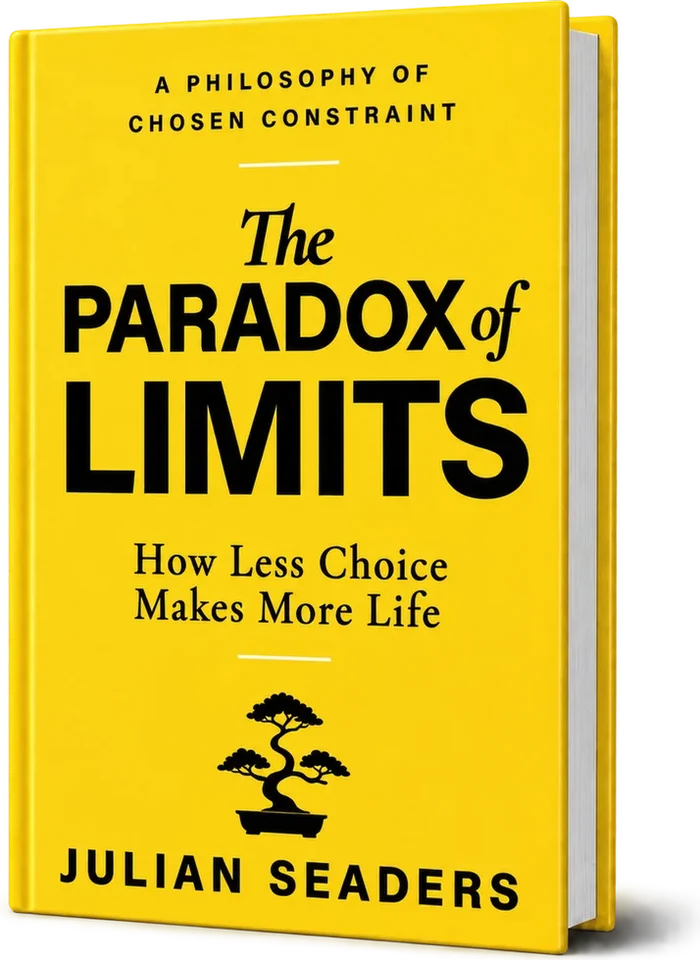
Why does more choice leave me with less?
The Paradox of Limits
Julian SeadersChapter 7 · Integrity as Constraint
“A coherent life is built one refusal at a time.”
15 chapters and a coda
Also inside
- Questions Worth Sitting With
- The Sacred Frame
- Creativity Under Pressure
- The Path to Mastery
4.6
Read an excerpt
Chapter 7 · Integrity as Constraint
A nine-year-old stands at the edge of the playground, spray paint pressed into his palm. His friends cluster around, their laughter sharp with dare and expectation. The wall before them is blank, waiting. For a moment, he feels the gravitational pull of belonging and the ease with which one burst from the nozzle could win their approval. The can feels heavier than it should, as if it contains more than paint. Then something inside him holds. No fear of punishment rises in him, no vision of adult authority at the edge of the playground, only something quieter and more certain. He hands the can back, shakes his head, and walks away.
Thirty years later, he won’t remember the color of the paint or the names of all the boys. But his body will remember the feeling of that first real no; the moment he discovered that he was someone who
could refuse, even when refusal meant standing alone. That small act of resistance laid the first stone in what would become the backbone of his character.
“I lost those friends,” he recalls now, watching his own son navigate similar pressures. “They stopped inviting me places, called me scared. But I gained something else, the knowledge that I could trust myself when it mattered. Every ethical decision since then has been easier because of that first one.”
Character rarely announces itself in grand declarations. It builds through accumulated refusals, through the unwatched moments when we choose not to cut the corner, not to shade the truth, not to take what isn’t ours. Each refusal feels insignificant at the time. The expense report you could have padded but didn’t. The gossip you could have spread but swallowed. The shortcut you could have taken but passed by. The credit you could have claimed
but gave to your colleague instead. These moments win no recognition, earn no praise. They pass unnoticed by everyone except the person making the choice.
Yet they become the load-bearing walls of a life, the structure that holds when pressure comes. Because pressure always comes, in the moment when padding the expense report becomes embezzling funds, when gossip becomes destroying someone’s reputation, when shortcuts become dangerous compromises. The person who has practiced refusal in small things finds they have the strength for refusal when everything is at stake.
“Integrity isn’t built in the crisis,” a whistleblower explains, having lost her job for exposing corporate fraud. “It’s built in the thousand tiny moments before the crisis, when no one is watching and the stakes seem low. By the time the big decision comes, you’re not choosing who to be; you’re revealing who you’ve already become.”
Contents
About the book
Modern life offers more freedom than any era before it. Countless career routes, limitless connection, an endless supply of information. Yet many people sense a quieter erosion underneath it all. Meaning feels thinner. Attention fractures. Life is busy, expansive, and oddly insubstantial. We are surrounded by choices, and paralyzed by them.
Julian Seaders explores how lives recover substance by showing how limits give shape rather than take away. Moving through work, family, faith, art, illness, and community, he reveals how commitments bring values into focus, refusals expose character, and boundaries transform time from something burned through into something genuinely lived. Again and again, significance appears when attention is guarded and choices are allowed to settle into form.
The argument unfolds through lived experience and a personal reckoning. A consultant discovers rest when an entire city stops working and time slows into something tangible. A business owner protects the foundation of her work by turning down growth that would empty it of meaning. Friends build uncommon intimacy by choosing one another over decades. And Seaders himself, exhausted by years of romantic paralysis, finds that the constraint he resisted became the clarity he lacked.
Beneath these stories runs a moral claim. Character is built through repeated acts of keeping one's word. Integrity takes root in refusals that carry real cost. Seaders handles privilege with care, separating limits imposed by circumstance from commitments chosen freely, and showing how responsibility begins with honest recognition.
The book also introduces a practical lens. The Explorer avoids commitment, the Builder creates structure, the Keeper deepens through devotion, and the Drifter remains comfortable with openness. These are not identities but capacities, and recognizing one's default is what makes the others accessible.
You already live within limits. Some arrive unchosen. Others are yours to decide. The form those choices take shapes who you become, and what your life is capable of holding.
Details & ISBNs
- Subtitle
- How Less Choice Makes More Life
- Publisher
- Supercritical Books
- Published
- 2026
- Pages
- 254
- Paperback ISBN
- 978-1-968988-31-9
- Hardcover ISBN
- 978-1-968988-30-2
- Ebook ASIN
- B0GX2YDYZN
Why does more choice leave me with less?
The long answer is 254 pages.
Choose a format
Choose a store