- From First Principles
- Part 1: Foundations
- 1What Patterns Hide
- 2What First Principles Actually Means
- 3The Philosophers Who Developed the Method
- Part 2: The Autodidact’s Path
- 4Learning Without Permission
- 5The Self-Taught Mind
- 6Curiosity as Discipline
- Part 3: Reduction and Reconstruction
- 7Breaking Problems Apart
- 8Root Cause Analysis
- 9Building From Bedrock
- Part 4: The Mind Against Itself
- 10Your Cognitive Distortions
- 11Mimetic Desire and What You Actually Want
- Part 5: Beyond Reduction
- 12Inversion
- 13Systems Thinking: When Wholes Exceed Parts
- 14Pattern Recognition and Generation
- Part 6: Synthesis
- 15Portraits of Mastery
- 16The Complete Thinker
- Glossary
How do I think clearly about a hard problem?
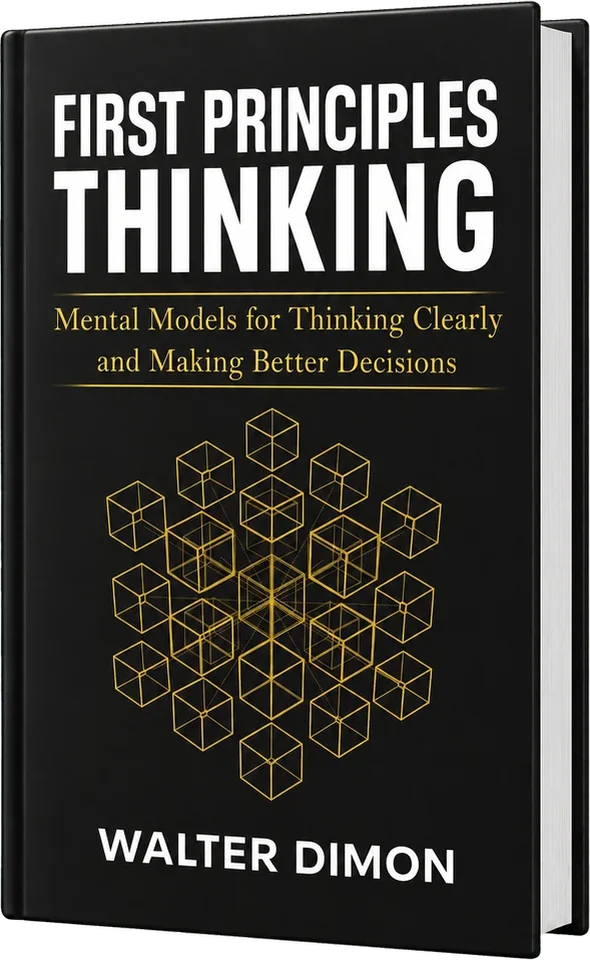
First Principles Thinking
Walter DimonChapter 4 · Learning Without Permission
“Permission is the first assumption the autodidact learns to question.”
16 chapters, from reduction to synthesis
Tools you will meet along the way
- Root Cause Analysis
- Building From Bedrock
- Inversion
- Systems Thinking
- Mimetic Desire
- Portraits of Mastery
A–Z glossary of mental models and key concepts
4.5
Read an excerpt
Chapter 7 · Breaking Problems Apart
In Harare, Zimbabwe, there is an office building that has no air conditioning. This would be unremarkable in a temperate climate, but Harare sits in the tropics, and the building, the Eastgate Centre, maintains comfortable temperatures year-round without conventional cooling systems. The architect, Mick Pearce, had studied how termite mounds in the region regulate their internal temperature. The insects build structures with elaborate ventilation channels that draw cool air from below ground and expel warm air through chimneys at the top. The mound breathes. Pearce wondered whether a building could do the same.
The Eastgate Centre uses massive concrete blocks that absorb heat during the day and release it at night. Fans draw air through the building in patterns inspired by the termite mounds. The design reduced the energy needed for heating and cooling by about ninety percent compared with conventional air conditioning. It works because Pearce questioned an assumption
that most architects treat as given: that modern buildings in hot climates require mechanical cooling.
The assumption felt like a physical constraint. Buildings must regulate temperature. People cannot work in extreme heat. Therefore, buildings need air conditioning. But the logic contains a hidden substitution. The fundamental requirement is temperature regulation. Air conditioning is one solution, not the only one. Traditional architecture across cultures developed effective strategies using orientation, cross-ventilation, material choice, and structural design long before mechanical cooling existed. The assumption that felt necessary was a default, a solution that had hardened into an expectation.
Every problem you try to solve carries assumptions like this. They form the invisible scaffolding underneath your thinking, telling you what must be true, what can vary, and what you never consider questioning. Most of the time, you do not notice them. They feel like the natural shape of reality, ideas you inherited or absorbed
along the way. First principles thinking begins with learning to see them.
An assumption is something you treat as given, a premise you accept without consciously deciding to accept it. These premises are not inherently bad. They make thinking possible. You could not move through daily life if you had to re-derive gravity each morning or rebuild the definition of money every time you made a purchase. Assumptions create stability. They let you solve new problems without reconstructing the universe from scratch.
The difficulty is that assumptions come in different kinds, and only some of them are genuine constraints. Gravity pulls objects downward. Materials behave according to their physical properties. Energy is conserved. These constraints are non-negotiable and form the bedrock of reasoning. Economic assumptions occupy a different level: resources are finite, people respond to incentives, choices carry opportunity costs. These are not universal in the way gravity is, but
they hold across broad contexts and provide stable grounding for decisions.
Beyond these lie assumptions that feel necessary but are not. Social conventions and domain traditions that once solved real problems now persist mostly by habit. A meeting does not need to last an hour. Most work does not need to happen between nine and five. Books do not need publishers if distribution and credibility can develop in new ways. Many ideas that feel like fundamentals are historical solutions that stopped being examined.
Contents
About the book
Most of what we believe, we inherited. From the assumptions that shape our careers to the habits that structure our days, we operate on patterns we never chose and rarely examine. Some of these patterns serve us well. Others persist simply because no one questioned them.
First principles thinking is the discipline of telling the difference.
The method is ancient. Aristotle, Descartes, and Galileo each used it to overturn what their predecessors assumed was settled. The same approach has since transformed industries, from shipping containers that reorganized global trade to reusable rockets that changed the economics of space.
First Principles Thinking explores how to properly apply the method. It begins with perception itself, the patterns your mind constructs before conscious thought begins, and shows why expertise can create blind spots as readily as insight. It then moves to application: how to decompose problems without losing what matters, how to trace failures back to their roots, how to rebuild from constraints that cannot be negotiated away.
The book also confronts what makes clear thinking difficult, from cognitive blind spots to mimetic desire to counterfeit confidence, and offers practical responses.
First principles thinking is one of several tools worth mastering. Properly understood, it is the foundation that determines when other tools should be used and when they should not. Some problems yield to inversion, reasoning backward from what must be avoided. Others require systems thinking, understanding how components interact in ways that reduction alone cannot predict. Still others reward pattern recognition, the trained intuition that sees structure where others see noise. First principles thinking does not compete with these approaches. It is what tells you when to use them and when breaking things down would destroy what matters.
The goal is to help you see problems clearly, reason from solid ground, and know which tool the moment requires. For anyone who suspects that the way things are done is not the way things must be done, this book offers a path to finding out.
Details & ISBNs
- Subtitle
- Mental Models for Thinking Clearly and Making Better Decisions
- Publisher
- Supercritical Books
- Published
- 2026
- Pages
- 370
- Paperback ISBN
- 978-1-968988-21-0
- Hardcover ISBN
- 978-1-968988-20-3
- Ebook ASIN
- B0GTZ8TDY6

How do I think clearly about a hard problem?
The long answer is 370 pages.
Choose a format
Choose a store
Prefer your local bookstore? Any shop can order it by ISBN.
978-1-968988-21-0