- The Catch and the Crash
- The System Beneath the Story
- The Timeline Gap
- The Demo and the Factory
- The Sideshows
- The Money Machine
- The Bailout
- The Political Dependency
- The Key-Man Problem
- The Forty-Four Billion Dollar Receipt
- The Conglomerate Graveyard
- The China Counterexample
- When Integration Loses
- The Human Cost
- The Price of the Driver
- The Trust Problem
- What the Real Companies Prove
- After the Founder
- The Promise Ledger
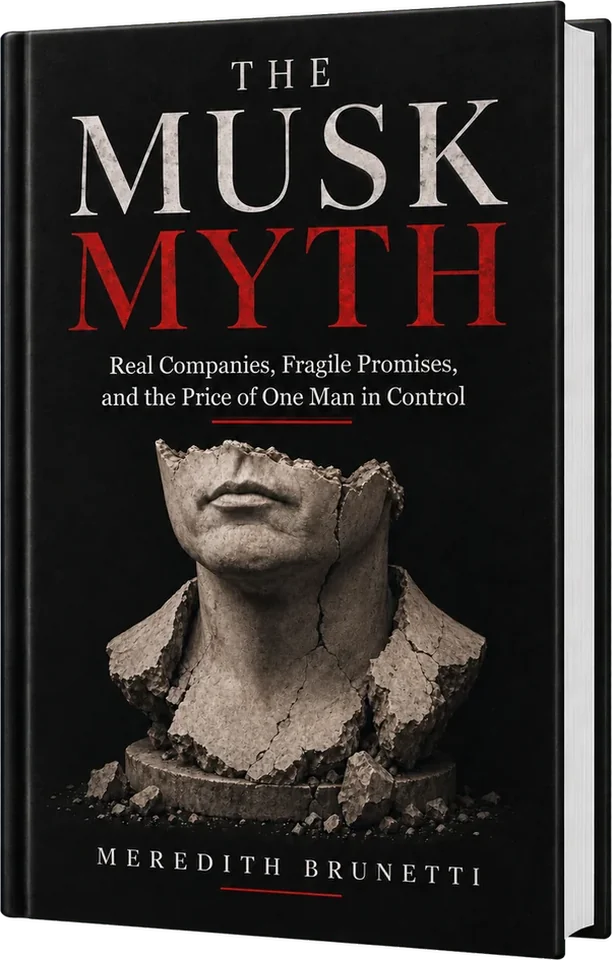
What are the risks of an empire built around Elon Musk?
The Musk Myth
Meredith BrunettiHIT 3LATE 9MISS 34MORPHED 6PENDING 4SPLIT 2
The Promise Ledger
“Each entry pairs a dated promise with what actually happened.”
$44B receipt, and other entries
Also inside
- The Bailout
- The Political Dependency
- The China Counterexample
- After the Founder
4.4
Read an excerpt
The Catch and the Crash
In October 2024, a seventy-meter rocket booster fell back toward the launch tower it had left minutes earlier, slowing as it dropped while two huge mechanical arms waited open. The arms closed around it in midair, the catch worked, and the people watching it happen shouted, laughed, and threw their arms up because the machine had done the impossible-looking thing in front of them.
Then the clip replayed everywhere, passed along by people who had never cared about rockets and suddenly did. For a general audience, this became the image of SpaceX, reusable spaceflight made visible to ordinary viewers, controlled on camera, and repeatable at industrial scale. If you remember one piece of SpaceX footage, it is probably this one.
Seven Starship flight tests later, in May 2026, an upgraded Starship/Super Heavy vehicle flew from the same development campaign. Starship’s upper stage climbed to the edge of orbit, released dummy
Starlink satellites, and made its planned fiery splashdown in the Indian Ocean. The booster was supposed to steer itself toward a controlled Gulf splashdown, a less theatrical test of the same reusability promise. Instead, after separation, Super Heavy flipped, lost most of its engines, and slammed into the Gulf of Mexico. A few days later, the Federal Aviation Administration filed the paperwork and called it a mishap. There is the image everyone remembers, and there is the image the company would rather you forget.
The crash replay does a different kind of work from the catch. The tower arms had given the public a clean object to admire. The Gulf gave the same promise back in a messier form, with telemetry, engine loss, impact, and regulatory procedure replacing the instant emotional release of a crowd watching a booster settle into steel arms. The catch sold the promise; the crash showed
the work still left.
Between the two clips is the book’s question. Much of the story is physical, in that it exists in steel and concrete, in code and battery cells, on launch pads and in orbiting machines. The rockets really do fly more often than most countries’ space programs. The satellites really do put a Montana farmhouse and a Ukrainian trench online. The cars really did force the old automakers to move faster than they wanted to move.
Two days before the May crash, on May 20, Musk offered the SpaceX story to public investors. A registration statement landed on the Securities and Exchange Commission’s servers, hundreds of pages that turned the private myth into shares the public could buy. Strip away the legal language and the proposition is unusually bold. The public was being invited to buy into a company valued between $1.75 trillion and $2 trillion before
many of its stated markets existed.
The story had moved beyond tweets and stage presentations. It had moved beyond private marks whispered among insiders. The grand vision now had legal language around it. It could be read by outsiders, priced in portfolios, and measured against disclosed claims.
Contents
About the book
The first cargo flights to Mars were scheduled for 2022. A million robotaxis were supposed to be earning money by 2020. Humanoid robots would take over the dull and dangerous jobs. As the years passed, the future kept being rescheduled, revised, and sold again as imminent, while anyone who pointed it out was told they did not understand the future.
The Musk Myth hands you the receipts. Meredith Brunetti gives Elon Musk full credit first. Tesla, SpaceX, and the Starlink network are real, built around achievements rivals said were impossible. Then she walks the record promise by promise.
Some of the dazzling demos do not survive scrutiny, and the grand vision leans on government money it cannot control, approvals that can be pulled, and belief priced as if it were output. Underneath the empire sits the part the believers rarely price in: the whole structure depends on one man staying solvent, focused, and politically usable, with almost everything routed back through him.
You will not hear the next promise the same way again.
Details & ISBNs
- Subtitle
- Real Companies, Fragile Promises, and the Price of One Man in Control
- Publisher
- Supercritical Books
- Published
- 2026
- Pages
- 326
- Paperback ISBN
- 978-1-968988-81-4
- Hardcover ISBN
- 978-1-968988-82-1
- Ebook ASIN
- B0H58Z1M32
What are the risks of an empire built around Elon Musk?
The long answer is 326 pages.
Choose a format
Choose a store