- The Orbital Layer
- Friday at Starbase
- Breaking the Launch Ceiling
- The Constellation
- The Industrial Base
- The Energy Ceiling
- Solar, Storage, and the Megapack
- The Factory as Technology
- The Labor Ceiling
- The Intelligence Layer
- The Unprotected Left
- Two Oceans of Data
- Chips as Choke Point
- One Day, Four Sites
- The Widening Gap
- The Civilization Stack
- Earth, Re-stacked
- Orbit as Industry
- Mars and the Kardashev Scale
- The Stack Outlives the Founder
- A Note on Sources
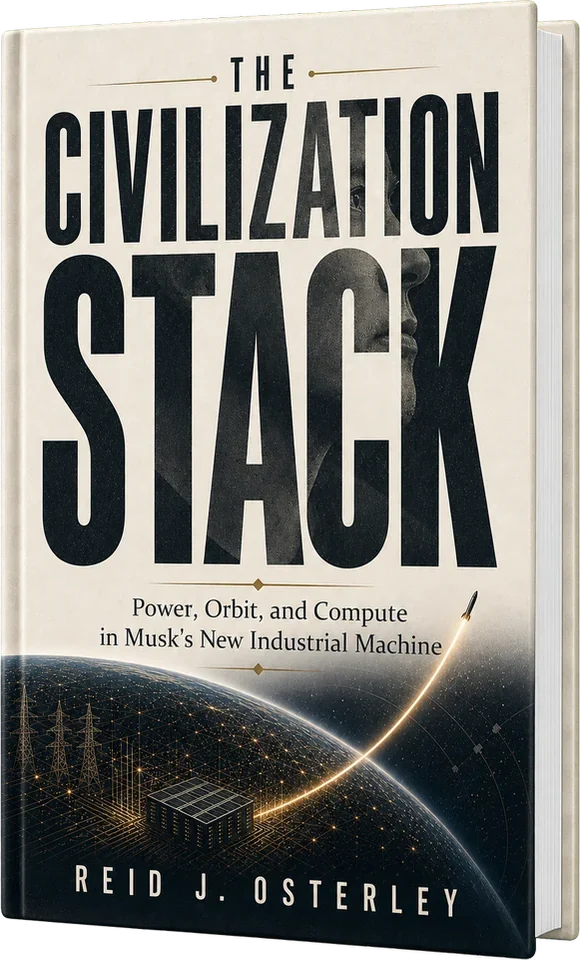
How do rockets, energy, and AI fit together?
The Civilization Stack
Reid J. OsterleyFriday at Starbase
“Every layer of a modern industrial system comes back, in the end, to silicon.”
3 ceilings the stack must break
Inside
- Breaking the Launch Ceiling
- The Energy Ceiling
- The Labor Ceiling
- Chips as Choke Point
- Orbit as Industry
4.6
Read an excerpt
Friday at Starbase
Before sunrise on May 22, 2026, the last range crews moved along the Boca Chica perimeter with flashlights low, checking the strip of Texas coast where dune grass, mudflat, tank farm, and launch tower had been crowded into a few hard-used acres. East of the pads the Gulf lay dark and close, its surface beginning to take a pewter wash, while the air had the warm salt thickness of the lower coast before daybreak. On the mount, Starship Version 3 rose in unpainted stainless, longer through the tanks and more severe in profile than the ships before it, its metal skin exposed because paint rides upward too and every needless pound leaves the pad as a tax on the mission. The vehicle kept changing from flight to flight, the tanks lengthened for propellant, the engines below revised for harder work, the plumbing pulled tighter inside the hull, each iteration bringing
the flying machine closer to the cargo ship the program meant to send past orbit. Floodlights laid a hard white glare up the body, exposing seams, frost bands, access ports, and the engine skirt in technical detail. As dawn opened over the Gulf, the light collected on the steel before it touched much else, and for a few minutes the flatness of water and salt grass gathered around that one bright vertical body.
This was Pad B. For most of the program’s life a single launch mount at Boca Chica had taken every Starship, one vehicle at a time, each flight held up by the damage the last one had left behind. A launch does real violence to the thing it stands on. Thirty-three engines lighting a few feet above the deck drove heat and pressure and debris straight back down, and in the early years a single liftoff had
cracked the concrete, thrown slabs of it out across the flats, and dug a crater under the table that took weeks to fill and pour again. With one pad, the whole site moved at the speed of that repair, a rocket spending a few seconds trying to destroy the table it launched from and a crew spending the next days putting it back. That bottleneck was what Pad B was built to break. With its own tower and its own deluge, it gave the program a second line, two vehicles working through stacking and test and flight without waiting on each other, and this morning that second line was flying for the first time since the pad had been cleared for it. The beach road had been shut since four. The county had pushed the public off the dunes, and inside the cordon there were only the people who worked
here.
There were close to two thousand of them on site that day. A great many had never held a job anywhere else. They had come out of universities and out of other people’s failed rocket companies and, increasingly, out of high schools in the Rio Grande Valley. They had learned the trade on this stretch of sand. No aerospace town had stood here before SpaceX built one. The company had made the place and then made the people for it, training them on its own hardware by crews it had trained the same way a few years earlier. The shift schedules ran around the clock, and the housing the company had thrown up nearby had turned a fishing hamlet into something closer to a company town, a few hundred people whose working lives were organized entirely around the cadence of the pad. North and west of the pads the…
Contents
About the book
A new industrial machine is being assembled in plain sight.
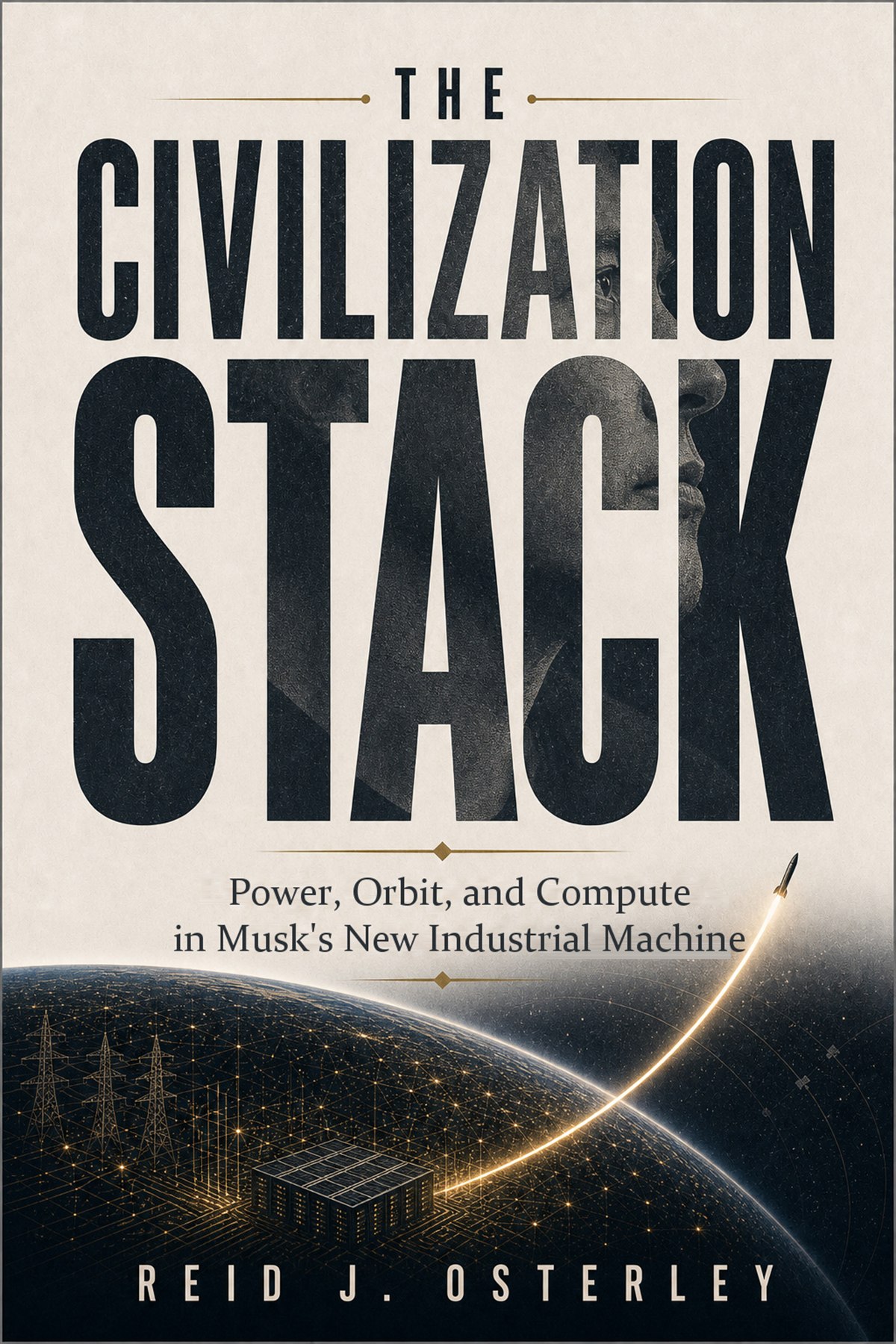
Across gigafactories, launch pads, satellite constellations, and AI data centers, Musk's companies are turning power, orbit, and compute into one system. The Civilization Stack follows the systems already running, the roadmaps taking physical form, and the infrastructure being built for what comes next.
Reid J. Osterley treats the machinery as the story, following reusable rockets, grid batteries, automated factories, chip supply chains, AI clusters, satellite networks, and the manufacturing tempo that binds them. Working from the public record, he shows how Tesla's industrial base, SpaceX's launch system, the Starlink network, the xAI compute buildout, and the supply chains that feed them are becoming layers in a single stack.
This is a book about the physical bottlenecks that decide what civilization can build next, and the industrial effort now being assembled to break through them.
Details & ISBNs
- Subtitle
- Power, Orbit, and Compute in Musk's New Industrial Machine
- Publisher
- Supercritical Books
- Published
- 2026
- Pages
- 336
- Paperback ISBN
- 978-1-968988-65-4
- Hardcover ISBN
- 978-1-968988-66-1
- Ebook ASIN
- B0GYKTPFCP
How do rockets, energy, and AI fit together?
The long answer is 336 pages.
Choose a format
Choose a store