- Preface
- Movement One: The Feeling
- 1Phones Beside Every Plate
- 2The Slot Machine in Your Hand
- 3The Attention Tax
- 4What Happens When You Stop Being Bored
- Movement Two: The Machine
- 5They Built This on Purpose
- 6The Plans I Kept to Myself
- 7After the Feed Stops
- 8Was Anyone There?
- 9The Feed Speaks First
- 10The Things You Still Want
- 11The Days That Leave No Story
- 12The Mood Without an Event
- Movement Three: Train It Back
- 13When Attention Started to Return
- 14What Do You Actually Like?
- 15The Audit
- 16Redesign the Input
- 17Rebuilding
- 18The Other Side
- 19What We Stopped Telling Each Other
- Afterword
- Find Your Ways In
- For Parents and Educators
- Glossary
Preface · Two Pages
“I lasted maybe six minutes before giving up and opening Instagram… and I did not look up for another forty-five minutes.”
21 questions. Seven ways in.
Which one sounds like you?
- The Checker
- The Researcher
- The Gap-Filler
- The One-Thing Scroller
- The Decompressor
- The Holdout Judge
- The Almost-Starter
7 days to test one small change
4.6
“It made me think about how I use my time and attention.”
“What stuck with me most was the idea that we don't always need more discipline but rather a realization of the things we're doing on autopilot”
Read an excerpt
Preface
This book began with a small embarrassment. I bought a novel I genuinely wanted to read and couldn’t get through two pages of it.
The novel was Gabrielle Zevin’s Tomorrow, and Tomorrow, and Tomorrow, which I bought at the Barnes & Noble in JFK before a flight in the summer of 2024. I read the back and had the small reader’s feeling that this one might be good. I could already imagine wanting to keep going. The book sat unopened for two weeks.
When I finally opened it, it was a Saturday night. I had cleared the evening on purpose. Nothing was scheduled, and the deadlines that could have followed me into the room were already handled. I had even removed the useful excuse, the kind that lets you tell yourself you’d have read if life had left you alone. It was just the couch, the book, and Earl Grey
in my favorite rose-pink mug.
I made it maybe two pages into the first chapter. The sentences were clear and the story was doing its job, but my eyes kept moving across the words while my attention slid off the page like water on glass. Every thirty seconds my hand drifted toward my phone. The reaching was automatic, a reflex I had somehow learned and seemed unable to override.
What bothered me was how poorly boredom explained it. I wanted the book and had chosen it on purpose. I kept reaching for the phone as if something on it might have changed. There was no message waiting for me and no emergency I needed to handle, but my hand moved anyway.
I lasted maybe six minutes before giving up and opening Instagram. Within seconds I was scrolling from one clip to the next, and I did not look up for
another forty-five minutes. The tea had gone cold while I was watching, and my eyes stung. I felt guilty because I had cleared the time for the book and spent it scrolling instead.
I picked the book back up and tried to get through one more page. Three paragraphs later, my hand reached for the phone again. Something had happened to my brain.
Contents
About the book
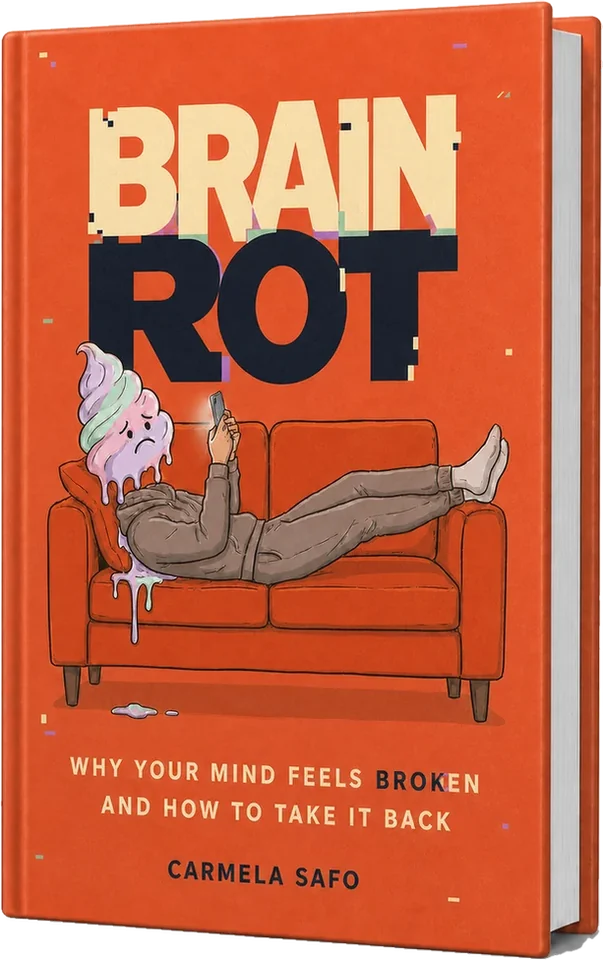
Scrolling for an hour has become easier than reading three pages of a book you love. Brain Rot is Carmela Safo’s story of hours lost to scrolling and her return to books and longer conversations.
She picks up the phone for one small task, then looks up half an hour later with the task still unfinished. At dinner, her partner starts giving her “the short version” because he expects her to check the phone while he is still explaining the difficult part.
To understand why she can’t focus anymore, Safo turns to published research on what makes social media feeds hard to leave and why she remains too restless to read or sleep after putting the phone down. She keeps using her phone throughout the day, but leaves it on the kitchen counter when she wants to read and puts it back once she has done what she picked it up for. Safo reads into the neuroscience of reward prediction and traces each study in the endnotes.
Brain Rot is for you if your attention span feels shorter than it used to and you struggle to stay with a book or conversation without checking the phone. At the back of the book, a 21-question assessment helps you identify how your scrolling sessions usually begin and what keeps them going. You use your result to choose one small change to test over seven days. Parents and educators can turn to the closing appendix for home and school defaults, conversation scripts, and warning signs that signal a need for real support.
Details & ISBNs
- Subtitle
- Why Your Mind Feels Broken and How to Take It Back
- Publisher
- Supercritical Books
- Published
- 2026
- Pages
- 240
- Paperback ISBN
- 978-1-968988-51-7
- Hardcover ISBN
- 978-1-968988-52-4
- Ebook ASIN
- B0HDZQJG2R
Why does my mind feel so scattered?
The long answer is 240 pages.
Choose a format
Choose a store